Built-Up Roofing (BUR)
Discover built-up roofing (BUR), its components, and benefits. Known as 'tar and gravel,' it's a durable and cost-effective option for low-slope roofs.
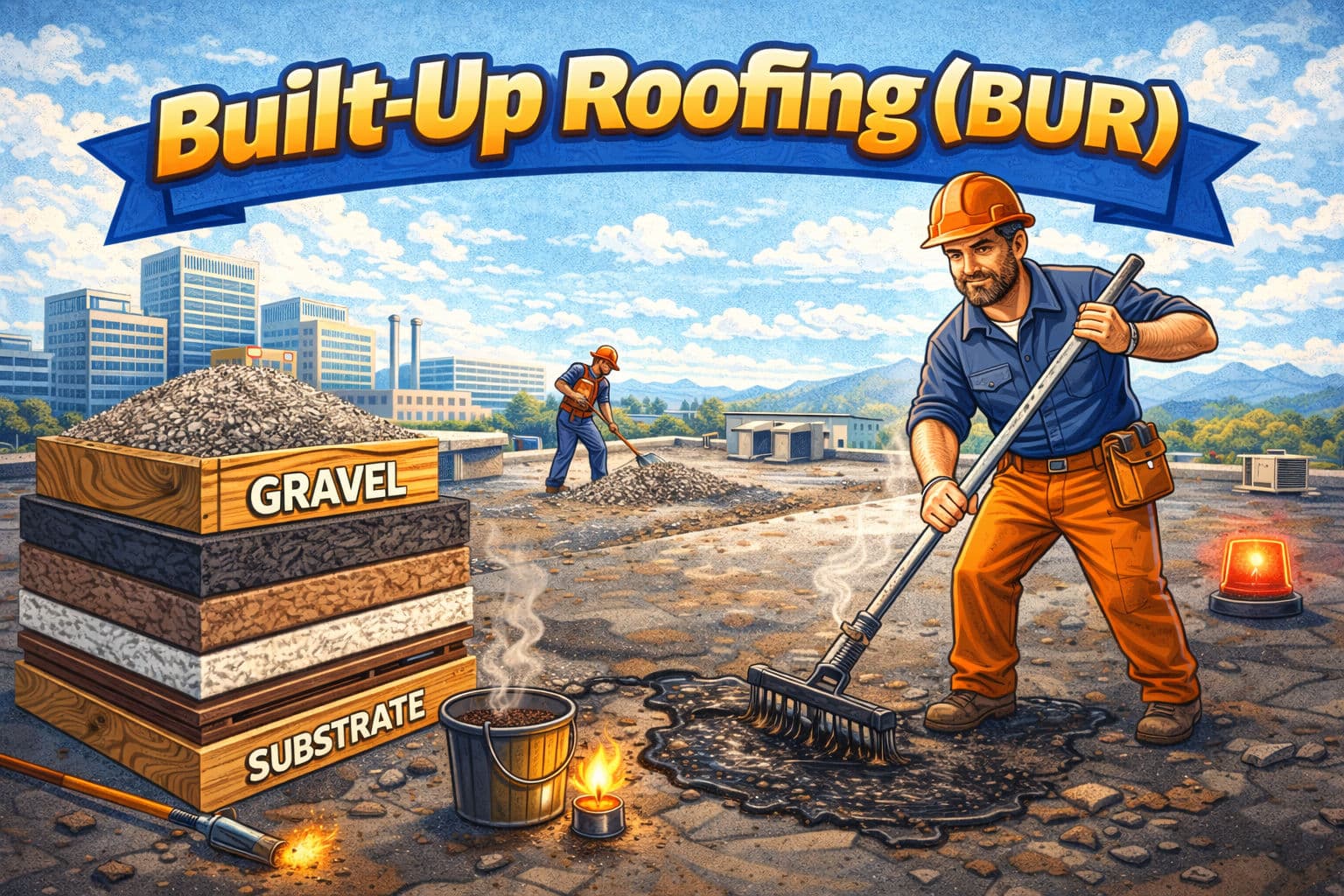
Built-up roofing (BUR), commonly known as “tar and gravel,” is a durable multi-ply roofing system designed for low-slope and flat roofs. It consists of alternating layers of bitumen—asphalt or cold app—and reinforcing fabrics such as fiberglass or felt. Most BUR systems are constructed with three to five plies and finished with a gravel, mineral, or reflective surfacing, providing excellent waterproofing, UV resistance, and long-term performance.
When properly installed and maintained, BUR systems typically deliver a service life of 20–30+ years, making them a cost-effective solution for many commercial and industrial buildings.
Key Aspects of Built-Up Roofing
Components
BUR systems include:
Bitumen (hot-applied asphalt or cold-applied adhesive)
Reinforcing felts (fiberglass, organic, or polyester)
Surfacing layers such as gravel/slag aggregate, mineral-surfaced cap sheets, or reflective coatings
Installation Method
BUR roofs are installed by layering reinforcing plies with bitumen to form a continuous, fully adhered waterproof membrane. The system is well suited for flat or low-slope commercial and industrial roofs.
Lifespan
A properly installed BUR roof typically lasts 20–30 years or longer, depending on installation quality, drainage, and maintenance.
Advantages
Excellent waterproofing through multi-ply redundancy
Strong UV protection, especially with gravel or mineral surfacing
Good resistance to foot traffic and hail
Frequently achieves Class A fire ratings
Generally lower lifecycle cost compared to some single-ply systems
Limitations
Heavy system weight may require structural evaluation
Installation is labor-intensive, especially hot-applied systems
Leak detection and repairs can be more complex due to multiple layers
Common Types of BUR Systems
1. BUR with Granulated Cap Sheet (2–3 Ply)
A base sheet—often mechanically fastened—is followed by one or two reinforcing plies mopped in hot asphalt or cold adhesive. A mineral-surfaced cap sheet is installed as the final layer.
This configuration replaces gravel with a cap-sheet surfacing for a cleaner finish.
2. Classic 4-Ply Flood-and-Gravel BUR
A fiberboard or cover board is mechanically fastened to the deck, followed by four reinforcing felts mopped in hot asphalt. The system is flood-coated with asphalt and embedded with gravel or slag.
This is the traditional heavy-duty BUR assembly.
3. Hybrid BUR / Modified Bitumen System
A 2–3 ply BUR base is installed and topped with a polymer-modified bitumen cap sheet.
NRCA classifies this as a modified bitumen system, though it is often referred to in the field as a hybrid BUR due to its hot-mopped base construction.
How BUR Systems Are Built
Membrane Construction
Alternating layers of bitumen and reinforcing felts—typically 36 inches wide—are installed to create a 3- to 5-ply membrane.
Attachment
Most BUR systems are fully adhered. Base sheets may be mechanically fastened, particularly over steel decks.
Surfacing Options
Flood coat with gravel or slag aggregate
Mineral-surfaced or glass-fiber cap sheets
Aluminum or elastomeric coatings for additional UV protection
Advantages in Colorado Front Range Conditions
Multi-ply redundancy provides superior leak resistance
Gravel-surfaced systems perform well under UV exposure, hail, and foot traffic
Strong fire performance, often achieving Class A ratings
Proven long-term performance in high-altitude, high-UV environments
Where Hybrid Systems Fit Best
A 2–3 ply BUR with a modified bitumen cap sheet combines:
The redundancy and thickness of BUR
The flexibility, durability, and cleaner surface of modified bitumen.